Helping Florida families make informed healthcare decisions with confidence.
How Private Duty Home Care Helps Older Adults Age Safely at Home
A Family Guide to Understanding Private Duty Home Care Services

Concerned About Someone You Love?
Talk With a Home Care Specialist.
If you’re noticing changes in a parent, spouse, or loved one and aren’t sure what they mean, we’re here to answer your questions and help you understand your options.
Schedule a Call Back
Not ready to talk?
What You'll Learn
Lisa’s Story: “Maybe Mom Doesn’t Need to Move After All.”
Lisa had been quietly worrying about her mother for months.
Nothing dramatic had happened. There had not been another hospitalization. Ruth had not fallen. No one had suggested assisted living.
Yet every visit left Lisa a little more concerned.
The refrigerator was not stocked the way it used to be. Laundry had begun piling up. Ruth admitted she sometimes skipped showers because she worried about falling. She had stopped meeting friends for lunch because driving no longer felt comfortable. Lisa noticed unopened mail on the kitchen counter and medications that were not always taken on time.
None of those changes felt like an emergency. Together, they painted a different picture.
Like many adult children, Lisa began asking herself a question she never thought she would have to ask: “Is it time for Mom to leave her home?”
The thought broke her heart. Her mother had lived there for almost forty years. Every room held memories. The neighbors knew her by name. She loved sitting on the back patio every morning with a cup of coffee while listening to the birds.
During a conversation with a healthcare professional, someone asked Lisa a question she had not considered: “Have you looked into private duty home care?”
Lisa admitted she was not even sure what that meant. She assumed it was medical care. It was not.

Ruth was not enthusiastic. She told Lisa she did not need a stranger in her house and that she was managing perfectly well. They agreed to try it for a month, with the understanding that Ruth could stop at any time.
A caregiver named Emily began visiting four mornings each week. She prepared breakfast, helped Ruth shower safely, reminded her about medications, picked up groceries, drove her to appointments, and went for short walks around the neighborhood. By the third week, Ruth had started setting out a second coffee cup before Emily arrived.
Nothing about the house changed. Everything about daily life became easier.
That is when Lisa realized something important: private duty home care was not about taking away her mother’s independence. It was helping her keep it.
Why Families Choose Care at Home First
Most people, if given the choice, would prefer to remain in their own home.
Home is familiar. It is comfortable. It is where birthdays were celebrated, grandchildren visited, and countless memories were made.
Remaining at home often allows older adults to maintain routines, stay connected with neighbors, keep beloved pets, and enjoy a level of independence that can be difficult to replicate elsewhere.
For many families, private duty home care makes that possible. Instead of leaving home because everyday tasks have become difficult, older adults receive the support they need while continuing to live in the place they know best.
That does not mean staying home is always the right answer. Sometimes a person’s medical condition or safety needs eventually require a higher level of care. Choosing assisted living or another residential setting is not a failure. It is another care decision based on changing needs.
The goal is never to remain at home at all costs. The goal is to help someone remain in the safest environment possible while preserving dignity, independence, and quality of life.
What Is Private Duty Home Care?
Private duty home care is non-medical assistance provided in a person’s home to help them remain safe, comfortable, and as independent as possible.
Unlike Medicare Home Health, which provides short-term skilled medical services ordered by a physician, private duty home care focuses on the everyday activities that often become more difficult as people age.
Services are personalized around the individual’s needs. For one person, that may mean help with bathing and dressing. For another, it may mean preparing meals, driving to appointments, shopping for groceries, or simply having someone present for companionship and reassurance.
Private duty home care does not replace independence. It supports it.
Family Insight
Private duty home care is not something families choose because they have given up. More often, they choose it because they want to help a loved one remain safely at home for as long as possible.
Why Families Begin Private Duty Home Care
Families rarely wake up one morning and decide they suddenly need a caregiver. The decision usually develops gradually.
It begins with small concerns: Mom is not eating as well. Dad has become unsteady walking to the mailbox. The laundry is not getting done. Someone misses medications. Driving no longer feels safe.
Sometimes adult children begin helping on evenings and weekends. Over time, those responsibilities grow. They begin stopping by every day, running errands, preparing meals, managing appointments, and trying to balance those responsibilities with careers, children, and their own families.
Private duty home care does not replace the family. It supports the family. It allows adult children to spend more time being sons and daughters—and less time trying to do everything alone.
When Should You Consider Private Duty Home Care?
There is no specific age or diagnosis that automatically means someone needs private duty care. Families often begin considering help when everyday activities become difficult, unsafe, or stressful.
Some families begin with only a few hours each week. Others require more frequent assistance from the beginning. The care plan should reflect the individual’s needs—not a predetermined schedule.
Family Insight
Many families believe they must wait for a crisis before asking for help. Starting earlier often prevents the very crises they are hoping to avoid.

What Caregivers Actually Do
Private duty caregivers assist with everyday activities that allow older adults to remain safe and independent at home. No two care plans are exactly alike, so the services are built around the individual.
1. Personal Care
- Bathing and showering
- Dressing and grooming
- Help using the bathroom safely, including incontinence care
- Oral hygiene and hair care
- Walking and mobility assistance
- Safe transfers into and out of beds or chairs
The aim is to provide enough assistance to keep someone safe while allowing them to continue doing as much as they can independently.
2. Meal Preparation and Nutrition
- Planning and preparing simple meals
- Encouraging healthy eating and hydration
- Assisting with grocery shopping
- Organizing the refrigerator and pantry
- Monitoring food freshness
3. Transportation and Community Activities
- Physician and therapy appointments
- Pharmacy and grocery trips
- Hair appointments
- Religious services
- Lunch with friends
- Community activities and personal errands
Transportation policies differ from one agency to another—some caregivers drive the client’s car, some drive their own, and some agencies do not provide transportation at all. Ask before care begins.
4. Light Housekeeping
- Laundry and changing bed linens
- Washing dishes and light kitchen cleanup
- Vacuuming high-traffic areas
- Taking out trash
- Organizing commonly used spaces
Caregivers are not maids or deep-cleaning professionals. Their focus is the client’s health, safety, comfort, and daily routine.
5. Medication Reminders
Caregivers commonly remind individuals when it is time to take medications and encourage adherence to an established routine. Medication reminders are different from medication administration. Caregivers generally do not administer medications unless permitted under applicable laws, regulations, and agency policies.
6. Companionship
Companionship—often called companion care—is the part of the service that families underestimate most. Conversation, sharing meals, playing cards, watching a favorite program, reading the newspaper, and taking walks can be just as meaningful as physical assistance. Companion care and personal care are usually delivered together by the same caregiver during the same visit: the caregiver who helps with a shower in the morning is also the person who sits down for coffee afterward. For many older adults, that second part becomes the most valuable hour of the day.
Family Insight
The best caregivers do not replace family. They make it possible for families to spend less time managing tasks and more time enjoying time together.

A Day with Emily
To give families a practical picture, here is an example of a four-hour morning visit with Emily, the caregiver who began visiting Lisa’s mother. Every care plan is different, so no two days look exactly alike.
8:00 AM — Good Morning
Emily arrives and spends a few minutes talking with Ruth about how she slept and how she feels. Emily notices Ruth seems slightly more tired than usual and plans to mention it to Lisa.
8:30 AM — Breakfast
They prepare breakfast together. Ruth pours her own coffee while Emily assists with the parts that have become difficult. Emily notices they are low on milk, fruit, and yogurt and adds them to the shopping list.
9:00 AM — Bathing Safely
Emily prepares the bathroom and stays nearby while Ruth showers. She provides assistance only when needed, allowing Ruth to do as much as she safely can herself.
9:45 AM — Getting Ready
Emily reminds Ruth that it is time for her morning medications and reviews the day’s calendar with her.
10:15 AM — Fresh Air
They take a short walk around the neighborhood, enjoying exercise, conversation, and time outside.
11:00 AM — Grocery Shopping
Ruth chooses fresh vegetables and fruit while Emily pushes the cart, carries groceries, and helps put everything away at home.
11:45 AM — Lunch and Tomorrow’s Plan
Emily prepares lunch, starts a load of laundry, straightens the kitchen, reviews tomorrow’s appointments, and updates Lisa before leaving.
Family Insight
The best caregiver visits often feel wonderfully ordinary. The goal is not to take over someone’s life. It is to make everyday life safer, easier, and more enjoyable.
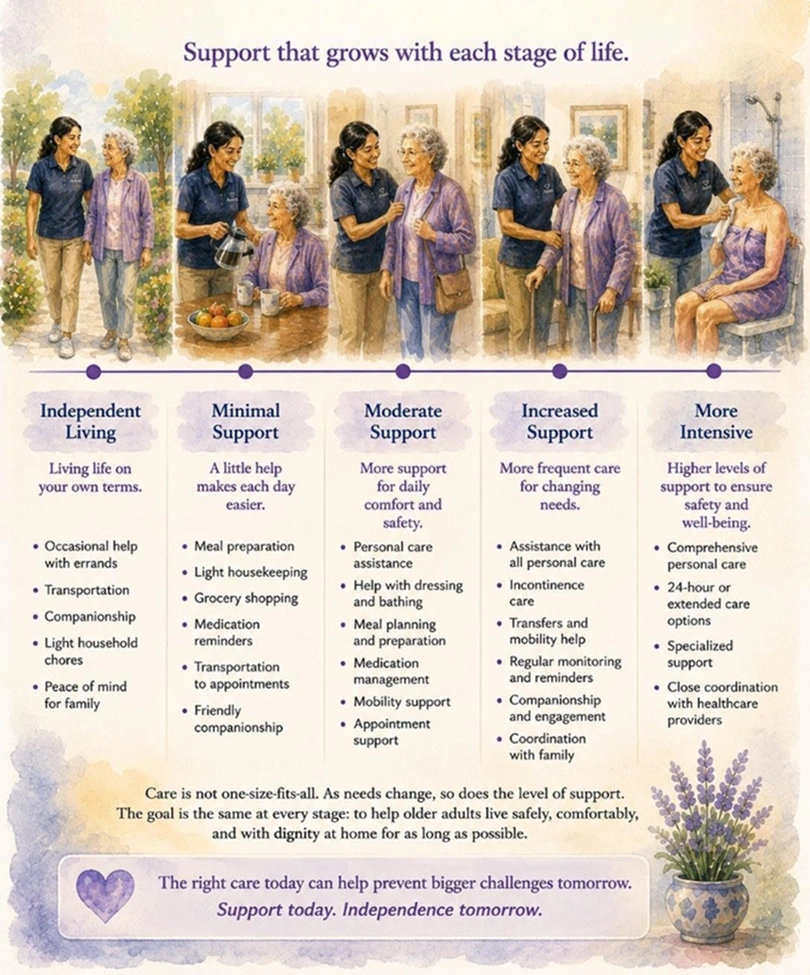
How Care Changes as Needs Change
A common misconception about private duty home care is that families must decide everything on day one.
Most care plans begin with a small amount of assistance and gradually change as a person’s needs change.
Lisa did not begin with full-time care. She started with four mornings each week. As Ruth’s needs changed, the schedule changed too.
Private duty home care is flexible because life is flexible. The right amount of care today may be different six months from now. The stages below match the illustration on the previous page.
Independent Living
Living life on your own terms, with a little backup. Often a few hours once or twice a week.
Minimal Support
A little help makes each day easier. Commonly four hours a day, three or four days each week.
Moderate Support
More support for daily comfort and safety. Commonly four to eight hours a day, five to seven days each week.
Increased Support
More frequent care for changing needs. Often eight to twelve hours a day, and appropriate when someone should not be alone for long periods.
More Intensive
Higher levels of support to ensure safety and well-being. May be considered for advanced memory impairment, major mobility limitations, or a need for continuous supervision.
Family Insight
Private duty home care is not an all-or-nothing decision. Most families begin with the smallest amount of help needed and adjust gradually.
Who Provides the Care?
When families invite someone into the home, they are placing tremendous trust in that person. Professional agencies select caregivers, complete background screening, verify credentials, and provide ongoing supervision.
Home Health Aides (HHAs)
Home Health Aides are trained to assist with personal care and activities of daily living, including bathing, dressing, grooming, walking, meals, light housekeeping, reminders, and companionship.
Certified Nursing Assistants (CNAs)
Home Health Aides (HHAs) provide personal care and help with daily activities—but only when these services are part of a skilled care Plan of Care. The specific services provided depend on state regulations, agency policies, and the individualized care plan. Families do not need to choose between the two credentials themselves: the agency matches the caregiver’s training to the needs identified in the assessment. It is fair to ask which credential has been assigned to your loved one and why.
Supervision Matters
What Private Duty Caregivers Do Not Do
Clear expectations protect both the client and the caregiver. Private duty caregivers generally do not:
When needs become more medical or complex, the agency should help the family understand whether additional skilled services or another level of care is appropriate.
How Private Duty Differs from Medicare Home Health
Private duty home care and Medicare Home Health are often confused because both are delivered at home. They serve different purposes.
Medicare Home Health | Private Duty Home Care | |
|---|---|---|
Type of care | Skilled medical services: nursing and physical, occupational, or speech therapy | Non-medical help with daily living, personal care, and companionship |
Who arranges it | Ordered by a physician | Arranged by the individual or family |
How long it lasts | Part-time or intermittent, for a defined period | Ongoing, for as long as it is needed and wanted |
Typical schedule | Short visits, a few times a week | Blocks of hours, from a few hours a week up to 24-hour care |
Who pays | Medicare, when coverage requirements are met | Usually private pay; long-term care insurance, Veterans benefits, or Florida Medicaid long-term care may apply |
Main goal | Recovery or clinical management after an illness or hospital stay | Safety, comfort, and independence in daily life |
Medicare generally does not pay for ongoing help with daily personal care—bathing, dressing, meals, and supervision—when that is the only care a person needs. Insurers sometimes call this custodial care.
A person may receive both services at the same time when eligible. For example, a Medicare-covered nurse or therapist may visit twice a week while a private duty caregiver helps with daily routines on the days in between.
How Families Pay for Private Duty Home Care
Understanding payment options helps families plan realistically and avoid surprises.
What It Costs
Private duty home care is billed by the hour. Most agencies also set a minimum visit length—commonly four hours—because very short visits make it difficult to provide dependable, consistent coverage. That is why so many care plans begin at four hours rather than one or two.
Total cost depends on how many hours are scheduled each week and the level of support required, so two families using the same agency can have very different monthly costs. When you contact an agency, ask for its current hourly rate, its minimum visit length, whether rates differ for nights, weekends, or holidays, and whether there is any charge for the initial assessment.
Private Pay
Most private duty home care is paid directly by the individual or family. Private pay allows schedules to begin quickly and change as needs evolve.
Long-Term Care Insurance
Many long-term care insurance policies help pay for private duty home care when policy requirements are met. Coverage varies considerably by policy: review the elimination period, the daily or monthly benefit limit, and whether the policy requires a licensed agency. A future guide in this series will cover long-term care insurance in detail.
Veterans Benefits
Some Veterans and surviving spouses may qualify for benefits that help offset the cost of home care. Eligibility depends on military service, financial circumstances, and program requirements.
Florida Medicaid Long-Term Care
Florida provides its Medicaid long-term care benefit through the Statewide Medicaid Managed Care Long-Term Care program, which can cover personal care, homemaker services, and other in-home support for people who meet both financial and medical eligibility requirements.
Enrollment is neither automatic nor immediate. Families begin with a telephone screening through their local Aging and Disability Resource Center, which produces a priority score used to place the person on a waitlist. Because that process takes time, some families begin private pay care while an application is pending. To request a screening, contact the Area Agency on Aging serving your county or call the statewide Elder Helpline at 1-800-96-ELDER (1-800-963-5337).
Other Resources
Depending on location and individual circumstances, community programs or other assistance may be available. A professional agency may help families identify potential resources.
Choosing the Right Home Care Agency
Inviting someone into the home is a deeply personal decision. Choosing the right agency matters just as much as choosing the right schedule.
Which type of license does the agency hold?
In Florida, in-home care is provided under different license types, and they are not interchangeable. A Home Health Agency license permits hands-on personal care such as bathing, dressing, and transfers. A Nurse Registry refers independent-contractor caregivers rather than employing them directly. A Homemaker and Companion Services registration permits housekeeping, meal preparation, errands, and companionship only—Florida law prohibits those providers from delivering any hands-on personal care.
If your loved one needs help bathing, dressing, or moving safely, confirm the agency holds a license that permits personal care. You can verify any Florida provider’s license type, status, and inspection history at FloridaHealthFinder.gov.

Is the agency insured?
Liability coverage and workers’ compensation protect the client, the family, and the caregiver. Ask whether caregivers are employees of the agency or independent contractors, because that determines who carries the insurance and who supervises the care.
How are caregivers screened?
Ask about background checks, references, employment screening, credentials, and training.
Who supervises the caregivers?
Ask how concerns are handled and how often the agency communicates with the family.
What happens if the regular caregiver is unavailable
A reliable agency should have a plan for illness, vacations, and emergencies.
Can the schedule change later?
The agency should be able to increase or decrease services as circumstances change.
How will the family receive updates?
Ask how visits are documented and how meaningful changes are communicated.
Family Insight
The best agencies do not simply send caregivers. They build dependable relationships with families.
What Happens When You Call
Families often delay calling because they are not sure what they are committing to. In most cases, the answer is nothing. Here is what the process usually looks like.
1. The first conversation
A short telephone call, usually fifteen or twenty minutes. You describe what is happening, the agency describes what it does, and together you decide whether an assessment makes sense. No commitment is made on this call.
2. The in-home assessment
A nurse or care manager visits the home, usually within a few days. They talk with your loved one, look at the home for safety concerns such as lighting, rugs, and bathroom access, and review medications, mobility, nutrition, and daily routines. Family members are welcome, and it helps when at least one is present. Most agencies do not charge for this visit.
3. The care plan
The agency puts in writing what will be done, on which days, and for how many hours, along with the cost. You should receive a copy. Read it, and say so if something is missing or wrong—this document is what the caregiver will work from.
4. Matching a caregiver
The agency selects a caregiver based on the skills the care plan requires and, where possible, on personality and shared interests. Ask to be told who is coming and a little about them before the first visit.
5. The first visits
Expect the first week to feel awkward. Most families find that a consistent routine settles in within two or three weeks. If the match is not working, say so early; a good agency expects that call and will not take it personally.
6. Ongoing review
Care plans should be reviewed on a regular schedule and any time something changes—a hospital stay, a fall, a new diagnosis, or a change in the family’s own availability.
What Families Often Worry About?
“Mom says she doesn’t need help.”
Focus on what assistance will allow her to continue doing safely, rather than what she can no longer do. Starting with a small schedule, or a trial period with a clear end date, often makes the transition easier.
“Will she feel like she is losing independence?”
Good care should support choice and independence. The caregiver should encourage the older adult to participate in decisions and continue doing what remains safe.
“Am I giving up too soon?”
Asking for help is not giving up. It is often a practical way to prevent burnout, reduce risk, and preserve the relationship between parent and child.
“What if the caregiver is not a good fit?”
Personality and trust matter. Families should feel comfortable asking the agency for a different caregiver when the match is not working.
Frequently Asked Questions
Yes. Many families begin with four-hour visits a few days each week, which is the minimum visit length at most agencies, and adjust from there.
For private pay care, often within a few days of the assessment. Care funded through insurance or a public program takes longer because eligibility must be confirmed first.
Agencies generally try to provide consistency, although substitutions may be necessary for vacations, illness, or schedule changes. Ask how the agency handles coverage before you sign anything.
Yes. Short-term care during recovery is one of the most common reasons families start, and there is no obligation to continue once your loved one is steady again.
That is what the assessment is for. It is also normal to begin with less help than you think you need and increase it after a few weeks, once you can see where the real gaps are.
Absolutely. Private duty care supports the family; it does not replace family involvement.
Often, yes. Familiar routines, gentle supervision, help with meals and personal care, and steady companionship can reduce agitation and lower the risk of falls, and many families use private duty care for years alongside a dementia diagnosis. What matters is matching the schedule to the person’s actual risks rather than to the diagnosis alone. Private duty care may not be enough on its own when someone is leaving the home unsafely, needs supervision through the night, has become unsafe for one caregiver to transfer, or has medical needs requiring skilled nursing. A good agency will tell you when that line is approaching and help you plan the next step rather than waiting for a crisis.
Key Takeaways

Closing Thoughts
When Lisa first began looking for help, she believed her only choices were to keep doing everything herself or move her mother into assisted living.
She eventually discovered another option.
Private duty home care did not change who Ruth was. It did not take away her independence. It did not replace family. It provided the extra support that allowed her to continue living safely in the home she loved.
Every family’s journey is different. Some people need only a few hours of help each week. Others eventually require more. Some ultimately decide that a higher level of care is the safest choice.
There is no single right answer for every family. What matters is finding the solution that provides the greatest safety, dignity, comfort, and quality of life.
Sometimes asking for help is exactly what allows someone to remain independent for much longer than anyone thought possible.
Final Thought
The goal is not simply to help someone stay at home. It is to help them stay safe, comfortable, and independent at home for as long as possible.
Trusted Resources
Families looking for additional information may find these organizations helpful.
About Avanti Home Health
At Avanti Home Health, we believe informed patients and caregivers make better healthcare decisions. The Avanti Family Care Guide Series provides clear, compassionate educational resources to help Florida families understand their care options with confidence.
To speak with someone about care for a loved one:
Telephone: 561-733-1390
Email: Kerry@avantiseniorcare.com
Website: www.avantiseniorcare.com
Counties served: Palm Beach, Martin, St. Lucie, and Indian River
Licensed by the Florida Agency for Health Care Administration (AHCA) — License #299993913
Educational Disclaimer
This publication is for general educational purposes only. It is not medical, legal, financial, or insurance advice, and it does not determine whether private duty home care is appropriate for any particular person. Program names, eligibility rules, and contact information change over time. Families should consult qualified healthcare professionals, licensed home care agencies, and the relevant state and federal agencies regarding their specific circumstances.
Related Family Care Guides